Free guide
Strength Training Through Perimenopause and Beyond
The short answer
"I picked up my first dumbbell at 54"
Lots of women tell me they’ve never lifted anything heavier than a shopping bag on purpose. Some think strength training is for younger women, or for people who love the gym. Others already exercise, but notice that the walking, running or classes that used to keep them fit don’t seem to work the same way anymore.
Wherever you’re starting from, strength training is for you. And it’s never too late to begin.
Why muscle matters more after 40
Your muscle declines unless you use it. From midlife, you slowly lose muscle each year unless you give it a reason to stay. Strength training is that reason.
Your bones need it too. As oestrogen falls, bones can lose strength. Exercise that loads your muscles and bones helps keep them strong.
It changes how your body uses energy. More muscle means your body uses more energy each day, even at rest. That’s why strength training helps with the shift in shape so many women notice around their middle.
It makes everyday life easier. Getting up off the floor, carrying the groceries, lifting a grandchild, getting out of a low chair. Strength is what keeps those things easy.
Australia’s physical activity guidelines recommend muscle strengthening activities on at least two days each week for adults.
A simple three day beginner plan
Do this on three days a week with a rest day in between (for example Monday, Wednesday and Friday). On the other days, go for a walk.
Warm up (3 minutes): march on the spot, roll your shoulders, swing your arms, and do a few slow sit to stands.
The session (about 20 minutes). Do each move 8 to 12 times, rest for a minute, then repeat the whole round once or twice.
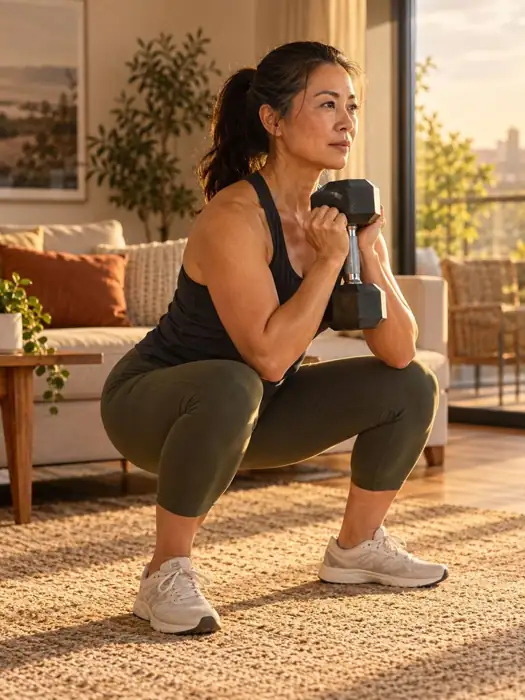
- Sit to stand. Sit on a sturdy chair, feet flat, then stand up without using your hands and sit back down slowly. Stronger: hold a dumbbell at your chest (a goblet squat).
- Wall or bench push-up. Hands on a wall or kitchen bench, body in a straight line, lower your chest towards your hands and push back. Stronger: use a lower surface.
- One arm row. One hand on a bench, a dumbbell or a full water bottle in the other hand, pull your elbow back towards your hip. Easier: use a lighter weight.
- Glute bridge. Lie on your back, knees bent, then lift your hips until your body makes a straight line from shoulders to knees. Stronger: hold a weight across your hips.
- Farmer’s carry. Hold a weight (or a full shopping bag) in each hand and walk tall for 20 to 30 steps.
Cool down: a few slow breaths and a gentle stretch for your legs, chest and back.
Graphic coming soon: the five moves as simple line drawings with one tip each
How to know it's working
Choose a weight that feels challenging by the last two or three reps, while you can still keep good form. When 12 reps feels easy, go up a little. That gradual increase is what builds strength.
Form tips that keep you safe
- Move slowly and with control, especially on the way down
- Breathe out as you push or lift
- Keep your shoulders away from your ears and your back long
- A little muscle tiredness is normal. Sharp pain isn’t, so stop and check in
- Start lighter than you think. You can always add more next week
If you’d like a simple strength session with demo videos, and a habit a week to support it, the 5R Blueprint includes your first strength sessions in Module 3.
When to see your GP
- A heart condition, high blood pressure, or chest pain when you’re active
- Dizziness or fainting
- A recent injury or surgery
- Osteoporosis or a history of fractures
- Any condition that could make exercise unsafe



Five gentle weeks to start feeling like yourself again
$167 · Start any time
Common questions
Is strength training safe in menopause?
How often should I strength train in perimenopause?
Do I need a gym?
Will lifting weights make me bulky?

Corrina Steele
Related guides

Australian Government Department of Health: Physical activity and exercise guidelines for adults
Better Health Channel: Menopause and weight gain